“I know he hurts me. I know I cry more than I smile. But I can’t leave. I don’t know how. I don’t know who I am without him.”
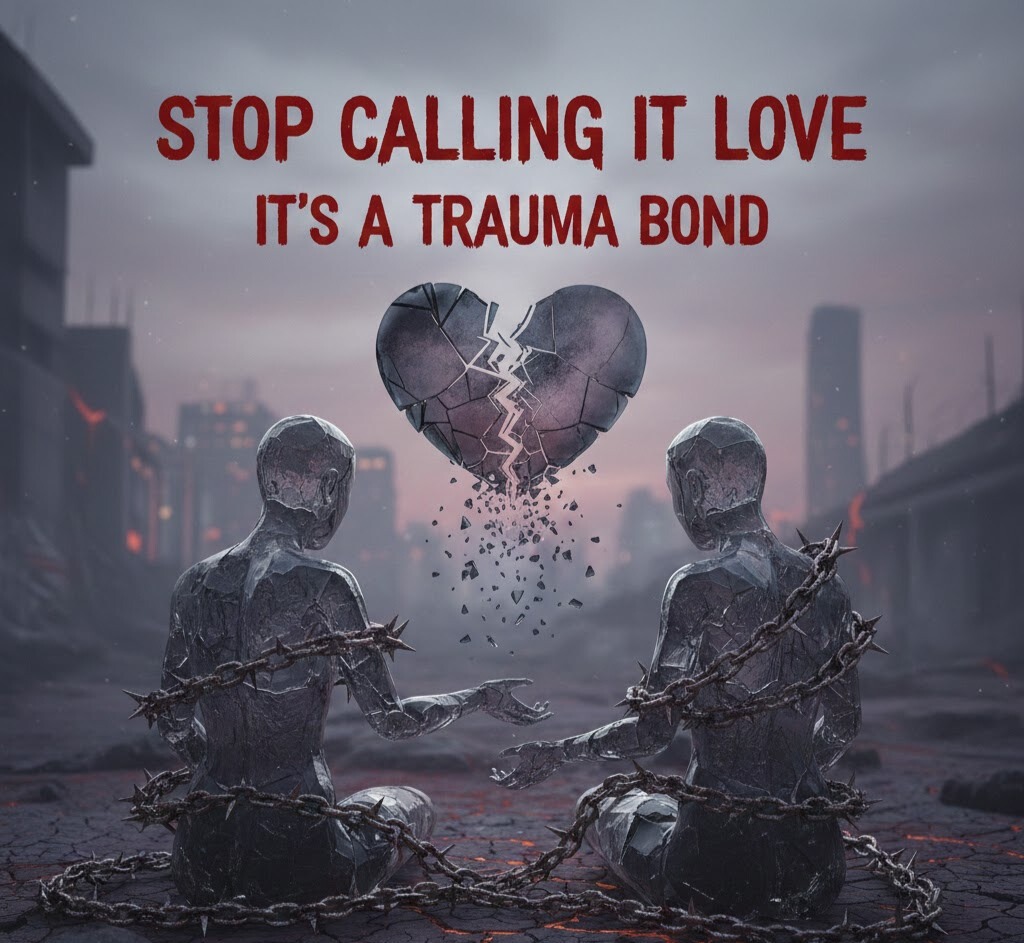
You have felt it before — that desperate, suffocating pull toward someone who is also the source of your deepest pain. You tell yourself it is love. You tell your friends it is love. You may have even told a therapist it is love. But what if it is not? What if what you are experiencing is something far more complex, far more painful, and far more dangerous than love — a trauma bond?
This is not written to shame you or to make you feel foolish for staying. It is written because you deserve to understand exactly what is happening inside your mind and body. Because the very first step to breaking free from something is knowing what you are actually breaking free from.
What Is a Trauma Bond?
A trauma bond is a deep psychological and emotional attachment that forms between two people — often between a victim and an abuser, or between two people in a highly volatile, dysfunctional relationship — as a result of repeated cycles of tension, harm, and intermittent warmth. The term was first coined by Dr. Patrick Carnes, who described it as a dysfunctional attachment that arises in the presence of danger, shame, or exploitation.
Put simply: your brain has been conditioned to crave the very person who is hurting you — because that same person has also given you moments of extreme relief, love, and validation. Your nervous system is not addicted to the person exactly. It is addicted to the cycle. The pattern. The unpredictable rhythm of pain followed by comfort that your brain has come to treat as normal.
If you have ever wondered why some relationships feel draining even when there is love, the answer very often lies in this dynamic — where genuine exhaustion and genuine attachment exist side by side, making it nearly impossible to see clearly from the inside.
The Science Behind Trauma Bonding
Trauma bonding is not a character flaw. It is not a weakness. It is a neurological response to a specific set of conditions. When you are in a state of fear or stress, your body releases cortisol and adrenaline. When the threat passes — when your partner apologizes, becomes tender, or returns after a period of coldness — your brain is flooded with dopamine and oxytocin, the same chemicals released when you fall in love. Over time, your brain learns to associate this person with both survival and reward simultaneously. It cannot separate the two.
This dynamic is often compared to intermittent reinforcement, which is the most psychologically powerful form of behavioral conditioning. When a reward is unpredictable — sometimes they are warm and loving, sometimes they are cold and cruel, and you never quite know which version will show up — the human brain becomes obsessively focused on obtaining that reward. It is the same psychological mechanism that makes slot machines so addictive. You stay because you never know when the good version of this person will return. And when they do return, the relief is so overwhelming that it reinforces every reason to hold on.
Understanding attachment issues in relationships and whether your childhood is still affecting you is essential context here. Many of our emotional responses to volatile relationships were shaped long before we ever met our current partners. Our nervous systems were patterned in childhood, and what feels familiar often feels like love — even when it is not.
Priya and the Cycle She Could Not Name

Priya was 28 years old when she first sat down in a counseling session. She had been with Rohan for four years. “When it’s good,” she said, “it’s the most beautiful thing I’ve ever experienced. He makes me feel like I’m everything to him.” But the bad times were devastating. Rohan would disappear for days without explanation. He would mock her in front of friends and then come home with flowers and tears. He would tell her she was lucky he stayed with her, and then in the same breath say he could not imagine life without her.
Priya had tried to leave three times. Each time she did, Rohan transformed into the man she had fallen in love with — attentive, apologetic, emotionally open. She went back every time, fully convinced that this version of him was the real one, and that the cruelty was something she had somehow caused. “Maybe I push him to act this way,” she would say. “Maybe I’m the problem.”
It took eight months of consistent therapy before Priya could finally see what was actually happening. She was not in love with Rohan. She was bonded to the hope of Rohan — to the version that appeared just long enough, just reliably enough, to keep her inside the cycle.
Priya’s story is not rare. It plays out in thousands of relationships across genders, ages, cultures, and backgrounds. And the particular tragedy is that most people inside trauma bonds spend years, sometimes decades, blaming themselves — convinced that love is simply supposed to feel this hard and this confusing.
How a Trauma Bond Differs From Real Love
This is the question that matters most, and it is also the hardest one to answer honestly. Trauma bonds feel like love — intensely, overwhelmingly so. The feelings are real. The attachment is real. That is precisely what makes them so difficult to walk away from.
But real love expands you. It feels like warmth, safety, and the freedom to be fully yourself without fear of punishment. Disagreements happen, of course, but the foundation is one of mutual respect and trust. You feel good about yourself because of the relationship, not in spite of it.
A trauma bond contracts you. It feeds on your fear of abandonment, your hunger for approval, and your inability to tolerate the discomfort of being alone. You feel desperate rather than secure. You find yourself constantly monitoring their moods, walking on eggshells, editing yourself endlessly, and measuring your own worth by how much they accept you on any given day.
There is a useful and honest distinction here: in real love, you choose to stay. In a trauma bond, it feels as though you cannot leave, even when every part of your rational mind knows you should.
If you want to understand what emotionally healthy love actually looks like in practice, reading about the habits of long-lasting couples and why love is built on consistency, not luck can offer a grounding comparison — a reminder of what you deserve to be working toward.
Eight Signs You Are in a Trauma Bond
You constantly justify their behavior to yourself and to others, explaining away cruelty with their difficult past, their stress, their bad day, or their complicated personality. You have tried to leave but always found yourself returning — not because you genuinely wanted to, but because the pull back to them felt physically unbearable, like a withdrawal you could not survive. You feel more anxious in this relationship than you feel at peace, always anticipating the next fight, the next disappearing act, or the next explosion. You have slowly lost yourself — your interests, your friendships, your opinions, your sense of humor — because you have been quietly editing yourself to keep them comfortable. The good times feel almost euphoric, especially after conflict, because their affection in those moments provides the most intense relief you have ever experienced. You blame yourself for what they do to you, believing that if you were calmer, more patient, less emotional, or simply better, they would stop hurting you. You have become increasingly isolated from the people who love you, whether because they pushed those people away directly or because the relationship has consumed so much of your energy there is nothing left. And finally, your sense of self-worth has become entirely dependent on their approval — their mood on any given morning determines how you feel about yourself for the rest of the day.
Arjun’s Invisible Cage

Arjun was 34 years old and genuinely did not believe that men could be trauma bonded. “She never hit me,” he said during his first session. “She just… controlled everything.” His partner would cry uncontrollably if he tried to spend an evening with friends. She would threaten to harm herself whenever he raised the idea of creating some space in the relationship. And yet, in quieter moments, she was the most loving, perceptive, and understanding person he had ever known. She seemed to see him in a way no one else ever had.
“I felt completely responsible for keeping her alive,” he said. “And when things were good between us, I felt more loved than I ever had in my life. I convinced myself that the chaos existed because she loved me too intensely. I told myself that’s just what deep love looks like.”
What Arjun was living was not deep love. It was emotional enmeshment, fear-based obligation, and a bond formed through the cycle of crisis and relief. Breaking free required him to rebuild his identity almost from scratch — to remember who he was before the relationship had quietly consumed him.
Why People Stay

It is easy for people on the outside of a trauma bond to ask why someone does not simply leave. But this question misunderstands what trauma bonding actually does to the human mind and body. Leaving can feel as neurologically threatening as abandoning a primary caregiver as a child — because the brain has literally wired those two things together. The person who hurts you and the person who soothes you are the same person, and your nervous system does not know how to want one without the other.
On top of that, trauma bonds are often layered with practical realities — shared finances, children, housing, careers intertwined. They are layered with cultural or family pressure to hold the relationship together no matter what. And they are often layered with shame: if I leave, it means I was foolish for staying so long. If I leave, it means I failed. If I leave, it means everything I felt was not real.
None of that is true. Staying is not a weakness. And leaving is not failure. It is often the most courageous act a person can take — the decision to choose themselves, perhaps for the very first time.
Understanding how to move on without rushing into a new relationship is one of the most important conversations to have after leaving a trauma bond. The temptation to fill the void immediately can be overwhelming, and it can lead directly into a new version of the same cycle.
The Role of Childhood Wounds

Many trauma bonds have roots that stretch back far before the current relationship. If you grew up in an environment where love was inconsistent — where a parent was sometimes nurturing and sometimes frightening, absent, or cruel — your nervous system learned very early that love and pain naturally coexist. That love must be earned and then re-earned, constantly. That anxiety and longing are simply what attachment feels like.
These early emotional blueprints lead us, as adults, to unconsciously seek out partners who recreate what is familiar — even when what is familiar is damaging. This is not pathology. It is the brain doing exactly what it was trained to do. But it is also something that can be understood, worked through, and genuinely healed.
The broader question of why modern relationships feel so confusing and how to approach them differently is deeply connected to this. When we carry unprocessed wounds from childhood into adult relationships, every moment of uncertainty becomes amplified, every conflict becomes existential, and every bit of coldness from a partner triggers something ancient and overwhelming inside us.
Meena Finds Her Way Out
Meena was 41 when she finally found the words for what she had been living for twelve years. “I thought I was just a difficult wife,” she said. “He always told me I was too sensitive. Too emotional. Too much.” Her husband moved between calling her the love of his life and telling her she was fortunate anyone could tolerate her. He would disappear into cold silence for days, then reappear warm and remorseful, promising that things would be different. And things would be different — for a while.
She had left twice. Both times he had wept, made genuine-seeming promises, and become the man she had first fallen for. Both times she returned, telling herself that the good version was the real version, and that the cruelty was something she had provoked.
It was a single session with a counselor — who named what she was experiencing as a trauma bond, clearly and without judgment — that changed something fundamental in how she understood her own life. “It wasn’t that I stopped loving him overnight,” she said. “It’s that I started asking a question I had never let myself ask before: is what I’m feeling actually love, or is it survival?”
Today, two years out of the marriage, Meena says she feels like herself again for the first time in over a decade.
Trauma Bonds in Almost Relationships
It is important to say clearly that trauma bonds do not only form inside long-term committed relationships. They can develop in situationships, in short but intensely volatile connections, and in what many people call almost relationships — connections that are never fully formed, never fully named, but that hold enormous emotional power.
The same cycle of intensity followed by withdrawal, of passionate closeness followed by sudden coldness, can create just as powerful a bond in six months as in six years. In some ways, the ambiguity makes it worse — because there is no formal ending, no agreed-upon grief, and no language for the loss. The bond keeps you hoping and waiting for something that was never fully offered.
If you have found yourself devastated by a connection that others did not take seriously because it never had a label, you are not overreacting. You might want to read about why almost relationships hurt more than breakups — because the pain is real, it is valid, and it deserves to be understood.
How to Begin Healing

Healing from a trauma bond is not linear and it cannot be rushed. There is no shortcut around the grief, the confusion, or the neurological withdrawal that comes when you remove yourself from the cycle. But it is entirely possible, and people do it every day.
The first and most important step is to name what you have been living. You are not crazy. You are not weak. You are not broken. You are responding to a genuine neurological and psychological phenomenon that has been studied, documented, and understood by researchers and clinicians for decades. Giving it a name is not an excuse. It is the beginning of clarity.
The second step is to seek professional support. Trauma bonds are deeply embedded patterns that typically require guided therapeutic work to untangle. A therapist or counselor trained in trauma and attachment can help you understand how your patterns formed, what keeps you inside them, and how to begin building something genuinely different. If you are unsure which therapeutic approach might be right for you, understanding the difference between mindfulness and CBT therapy and which one is right for you is a good place to begin exploring your options.
The third step is to rebuild your support network. Isolation is one of the most consistent features of trauma-bonded relationships. Reconnecting with friends, family members, or community — people who reflect your real worth back to you, who knew you before the relationship consumed you — is not a luxury. It is part of the treatment.
The fourth step, where possible, is to limit or eliminate contact with the person who has trauma bonded you. Every point of contact — even a brief text, even checking their social media, even hearing their name from a mutual friend — can restart the neurological cycle. No-contact, or strictly limited contact, gives your brain the space it needs to begin rewiring itself.
And through all of it: practice radical self-compassion. You stayed because your nervous system was conditioned to. You went back because your brain was flooded with chemicals every time you did. You are not to blame for the way you were shaped. Healing begins when you stop directing the harshest judgment inward and start extending to yourself even a fraction of the grace you have been giving to the person who hurt you.
If you are not sure whether in-person or online therapy feels more accessible for where you are right now, reading about online versus in-person counseling and which option is better can help you make that decision without pressure.
And when you are ready to take the next step forward — not rushing, not filling the void, but genuinely beginning to rebuild — understanding how to heal after a breakup through a step-by-step emotional recovery guide offers practical, grounded support for what comes after you leave.
The Truth About Love
Real love does not require you to lose yourself to keep it. Real love does not cycle through cruelty and tenderness in a pattern that leaves you too disoriented to trust your own perceptions. Real love does not make you feel like you are constantly on trial, constantly proving yourself, constantly one wrong move away from being abandoned.
What you have been calling love — the desperate, all-consuming, cannot-eat-cannot-sleep, would-do-anything-to-keep-it feeling — is real. The feelings are real. The attachment is real. But the source of those feelings may not be love. It may be a wound that has been cleverly disguised as one.
You deserve to know the difference. You deserve to feel the difference. And with time, support, and the willingness to look honestly at what has been happening, you will.
Frequently Asked Questions
1. Is a trauma bond the same as codependency?
They overlap but they are not the same thing. Codependency refers to an unhealthy reliance on another person for emotional regulation and validation, often rooted in a compulsion to control or rescue. A trauma bond specifically forms as a result of cycles of abuse and intermittent reinforcement — harm followed by relief. Codependency can exist without abuse. Trauma bonding cannot.
2. Can men be in trauma bonds?
Absolutely. Trauma bonding does not discriminate by gender. Men are often less likely to identify it because cultural norms make it harder for men to acknowledge emotional vulnerability or to name manipulation in their relationships as a form of abuse. But emotional, psychological, and physical abuse toward men is real, and the bonds it creates are just as powerful and just as deserving of care and attention.
3. How long does it take to break a trauma bond?
There is no fixed answer. For some people, naming the dynamic creates a significant internal shift within weeks. For others — particularly those in very long relationships or those carrying compounding childhood trauma — genuine healing may take a year or more of consistent work. The goal is not speed. The goal is sustainable change that holds over time.
4. Can the relationship be saved if it is a trauma bond?
In rare circumstances, if both people genuinely recognize the dynamic, take full accountability, and commit seriously to both individual and couples therapy, real change is possible. However, this requires the person who caused harm to do far more than apologize — it requires sustained behavioral change over a long period. Where abuse is present, leaving is almost always the safer path.
5. Why do I still miss them even though I know they hurt me?
This is one of the most painful and confusing aspects of leaving a trauma bond. Missing them is not evidence that you love them or that you made the wrong decision. It is your nervous system going through a genuine chemical withdrawal from the dopamine cycle it had become dependent on. The craving is neurological. It is not a moral failing. It will diminish with time, distance, and support — even when it does not feel that way at first.
6. Is the person who trauma bonded me doing it intentionally?
Not always. Some people who create trauma bonds are doing so unconsciously, reenacting their own early wounds and unresolved attachment patterns without any deliberate awareness of the harm they are causing. This does not make the harm less real. It does not mean you should stay. But understanding it can sometimes help release some of the confusion — and recognize that both people in these dynamics are often carrying damage that predates the relationship itself.
7. What type of therapy is best for healing from a trauma bond?
Several approaches have strong evidence behind them for trauma recovery. These include Trauma-Focused Cognitive Behavioral Therapy, EMDR (Eye Movement Desensitization and Reprocessing), Internal Family Systems therapy, and somatic or body-based approaches. A trauma-informed therapist can help you assess which approach fits your particular history and needs.
8. How do I know if I am forming a new trauma bond in a new relationship?
Watch for the early warning signs. Do you feel anxious and hypervigilant rather than at ease? Do you feel you must constantly earn their interest or approval? Is there a pattern of intense closeness followed by inexplicable coldness? Do you find yourself making excuses for their behavior very early on? After leaving a trauma bond, healing your nervous system before fully entering a new relationship is one of the most protective things you can do for yourself.
9. Can online therapy help with trauma bond recovery?
Yes. Research consistently supports the effectiveness of online therapy for trauma-related concerns. For many people it removes the barriers of geography, scheduling, stigma, and cost that might otherwise delay getting help. The modality matters less than the quality of the therapeutic relationship and the training of the person you are working with.
10. What is the very first step I should take if I think I am in a trauma bond?
The first step is exactly what you have already done by reading this: allowing yourself to look at the situation honestly without immediately defending it. The second step is to tell someone you trust — a friend, a family member, or a professional — what you have been experiencing. You do not have to figure this out alone, and you do not have to have everything decided before you reach out. The act of speaking it out loud, of letting someone else bear witness to what you have been carrying, is itself the beginning of healing.