Most of us have heard both terms thrown around in conversations about dating and relationships. Someone says “That’s a red flag” and another person says “That’s a deal breaker for me.” But here’s the truth — most people use these two terms interchangeably, and that’s a costly mistake.
Understanding the difference between a red flag and a deal breaker isn’t just relationship trivia. It’s one of the most important emotional skills you can develop. It determines who you choose to be with, how long you stay, and whether you leave before or after the damage is done.
If you’ve ever found yourself confused about whether something your partner does is a warning sign or an absolute non-negotiable, this blog is for you. And if you want to explore more about relationship patterns.
What Is a Red Flag?
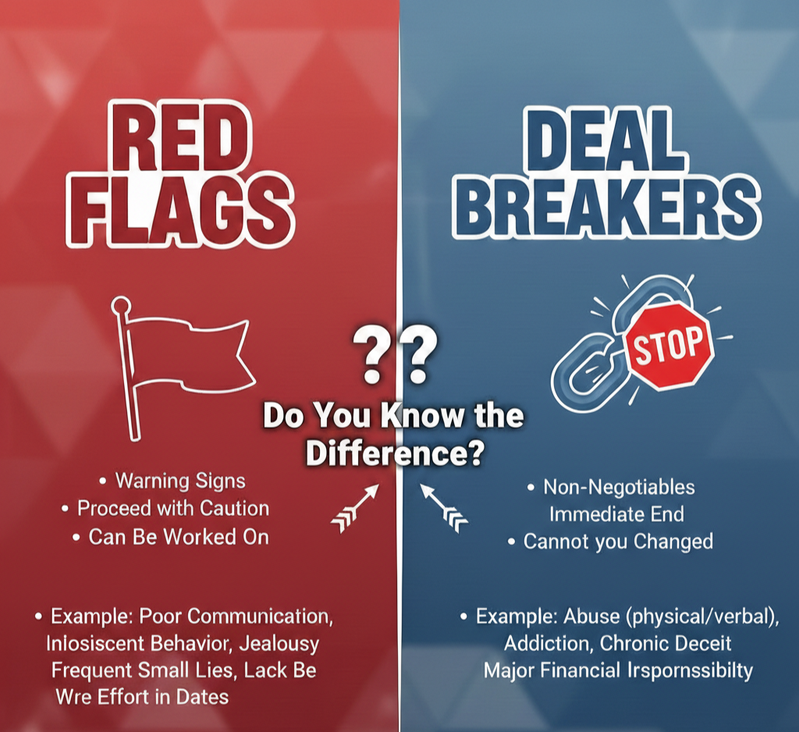
A red flag is a warning sign. It’s something that signals a potential problem in a relationship — a behavior, pattern, or trait that deserves your attention and careful observation. Red flags don’t always mean run immediately. They mean: pay attention.
Think of a red flag like the ‘check engine‘ light in your car. It doesn’t necessarily mean your car is about to explode. It means something needs to be looked at. You don’t throw the car away, but you also don’t ignore the warning.
Common red flags include:
• Your partner gets defensive or angry whenever you raise a concern.
• They make dismissive comments about your feelings.
• They cancel plans often without valid explanation.
• Their words and actions don’t align consistently.
• They speak poorly about all their exes.
• They have trouble taking responsibility for their mistakes.
Red flags are patterns that could escalate into more serious problems — or they could be addressed with honest communication and growth. The keyword here is could. They require your awareness and judgment, not an automatic exit.
What Is a Deal Breaker?
A deal breaker is different. It’s not a warning — it’s a boundary. A deal breaker is a condition so fundamental to your values, wellbeing, or future that if it exists in a relationship, the relationship simply cannot work — at least not for you.
Deal breakers are non-negotiable. They are the lines you draw based on who you are, what you need, and what you absolutely cannot live with or without.
Common deal breakers include:
• Wanting children vs. not wanting children.
• Fundamental differences in religion or values.
• Substance abuse that the partner is unwilling to address.
• Physical, emotional, or verbal abuse of any kind.
• Infidelity (for those who are not in non-monogamous arrangements).
• Unwillingness to seek help for mental health issues that significantly affect the relationship.
The critical thing about a deal breaker is that it’s personal. What is a deal breaker for you might not be for someone else. That’s okay. Your deal breakers come from your own values, experiences, and needs — and they deserve respect.
The Core Difference: Warning vs. Boundary
Here’s the simplest way to remember it:
A red flag says: “Watch out. Something might be wrong here.”
A deal breaker says: “This is something I cannot accept in a relationship, period.”
Red flags invite conversation and observation. Deal breakers require a decision.
When you confuse the two, one of two things happens: you either treat every small red flag as a deal breaker and find yourself walking away from relationships that could have grown into something beautiful, or — more dangerously — you treat actual deal breakers as mere red flags and stay in situations that slowly erode your mental and emotional health.
Want to understand more about how relationship patterns affect your wellbeing? Explore our related articles on healing and emotional recovery.
Why People Confuse the Two
1. We’re Taught to ‘Try Harder’
Societal messaging — especially for women — often pushes us to dismiss legitimate deal breakers as things to ‘work through.’ We’ve been conditioned to believe that leaving equals failure. So we rationalize deal breakers as just red flags, tell ourselves it’ll get better, and stay far longer than we should.
2. Love Clouds Judgment
When you’re deeply in love, your brain literally functions differently. The reward circuits associated with attachment and bonding make it harder to evaluate a situation objectively. This is why you might intellectually know something is a deal breaker but emotionally minimize it.
3. Fear of Being Alone
The fear of loneliness is real and powerful. It causes many people to reclassify their deal breakers as negotiable, just to avoid the discomfort of being single. If you’ve ever thought, “Maybe this is as good as it gets,” this fear might be doing the work for you.
4. Hoping They’ll Change
People do change — but only when they want to and when they’re willing to put in the work. Staying in a relationship based on who you hope someone will become rather than who they are now is one of the most common traps people fall into.
How to Identify Your Personal Deal Breakers
Your deal breakers should be deeply personal and well thought-out — not impulsive or based on superficial preferences. Here’s how to identify them:
Reflect on Past Relationships
Think about what has caused you the most pain, resentment, or loss of self in previous relationships. The things that broke you — not challenged you, but broke you — are often pointing to your real deal breakers.
Know Your Core Values
Deal breakers are often tied to core values. If family is everything to you and your partner has no interest in building one, that’s not just a difference of opinion — it’s a fundamental incompatibility.
Ask Yourself: Can I Live With This Forever?
Here’s a powerful test: imagine this trait or behavior never changing. Can you genuinely live with it and still feel content, respected, and loved? If the answer is no — that’s your deal breaker.
Separate Preferences From Principles
Wanting your partner to be taller or love the same music are preferences. Needing your partner to be honest and emotionally available are principles. Deal breakers live in the world of principles, not preferences.
How to Handle a Red Flag (Without Overreacting or Dismissing It)
Once you’ve spotted a red flag, here’s what to do:
1. Name it clearly. Don’t minimize. Acknowledge to yourself what you observed.
2. Communicate. Raise it with your partner in a calm, non-accusatory way. Their response will tell you a lot.
3. Observe the pattern. Is this a one-time thing or a recurring behavior? Patterns are more telling than isolated incidents.
4. Seek support. Sometimes it helps to talk to a counselor or therapist who can give you an objective perspective.
5. Set a timeline. Give the relationship a fair but defined window to show growth. Open-ended waiting is a path to resentment.
The Danger of Ignoring Deal Breakers
Staying in a relationship that violates your deal breakers doesn’t just make you unhappy — it can cause real, lasting damage to your mental health, self-esteem, and sense of identity.
When you repeatedly override your own boundaries, you send a message to yourself that your needs don’t matter. Over time, this creates patterns of self-abandonment — where you stop trusting your own instincts and judgments.
Many people who have ignored deal breakers for years describe the experience as slowly losing themselves — they became so focused on making the relationship work that they forgot who they were outside of it.
This is deeply connected to concepts like trauma bonding and codependency — patterns .
Real-Life Scenarios: Red Flag or Deal Breaker?
Scenario 1: Your partner frequently interrupts you in conversations.
Red flag. This could point to a lack of respect or emotional awareness — but it could also be a learned habit that can change with honest feedback and effort.
Scenario 2: Your partner refuses to ever discuss marriage or long-term commitment after two years together.
Potential deal breaker — especially if building a family or a committed future is important to you. This is a fundamental compatibility issue.
Scenario 3: Your partner got jealous when you spent time with a close friend.
Red flag — but context matters. Occasional insecurity can be worked through. Controlling behavior that escalates or isolates you from others is a deal breaker.
Scenario 4: Your partner physically intimidates you during arguments.
Deal breaker Always Physical intimidation is a form of abuse. No amount of love, history, or potential justifies staying in a situation where you feel physically unsafe.
Conclusion: Know the Difference — and Know Yourself
The most important relationship skill you can build is self-knowledge. When you know your values, your boundaries, and what you genuinely need from a partner, the difference between a red flag and a deal breaker becomes much clearer.
Red flags deserve your attention and a conversation. Deal breakers deserve your honesty — with your partner and with yourself.
You are not too picky for having deal breakers. You are not overreacting by noticing red flags. You are someone who values yourself enough to pay attention.
And that, ultimately, is the foundation of every healthy relationship.
Frequently Asked Questions (FAQs)
1. What is the main difference between a red flag and a deal breaker?
A red flag is a warning sign that something in the relationship may need attention or discussion. A deal breaker is a non-negotiable condition — something so fundamentally incompatible with your values or needs that the relationship cannot continue if it exists.
2. Can a red flag become a deal breaker?
Yes. If a red flag is ignored, minimized, or repeatedly dismissed by your partner despite communication efforts, it can absolutely evolve into a deal breaker. The pattern and response to red flags often determine whether they become deal breakers.
3. Is it okay to have deal breakers in a relationship?
Absolutely. Having deal breakers is a sign of self-awareness and self-respect. Knowing what you fundamentally cannot accept in a relationship is healthy, not demanding. It protects you and your partner from prolonged incompatibility.
4. How do I know if I’m being too rigid with my deal breakers?
Ask yourself: Is this about a core value or principle, or is it about a preference or ideal? If it’s the latter, you might be confusing standards with rigidity. If it’s truly about your values, wellbeing, or safety — it’s a legitimate deal breaker.
5. What are the most common red flags people ignore?
Some of the most commonly ignored red flags include: inconsistency between words and actions, frequent defensiveness, dismissiveness toward your feelings, excessive jealousy, and patterns of blame-shifting.
6. Can someone change their red flag behaviors?
Yes — but only if they are willing and actively working to change. Change requires self-awareness, effort, and often professional support like counseling. Love alone is not enough to change deep behavioral patterns.
7. Are deal breakers the same for everyone?
No. Deal breakers are deeply personal and shaped by your values, past experiences, and life goals. What is a deal breaker for one person may not be for another — and that’s completely valid. The key is being honest with yourself about what you are.
8. Is staying in a relationship with red flags always a bad idea?
Not necessarily. Red flags are warning signs, not automatic exit signs. If your partner is willing to acknowledge the behavior, communicate openly, and make genuine effort to grow, a red flag doesn’t have to end the relationship.
9. How do I bring up a red flag to my partner without starting a fight?
Use “I” statements rather than accusations. For example: “I feel worried when plans change at the last minute — can we talk about this?” Stay calm, choose a good time, and approach it as a conversation, not a confrontation.
10. When should I walk away from a relationship?
Walk away when: your deal breakers are being violated repeatedly and your partner is unwilling to change; when your safety — physical or emotional — is at risk; or when you have communicated your concerns and seen no genuine effort over time. Your wellbeing always comes first. If you need guidance navigating this decision, our healing resources are here to help.