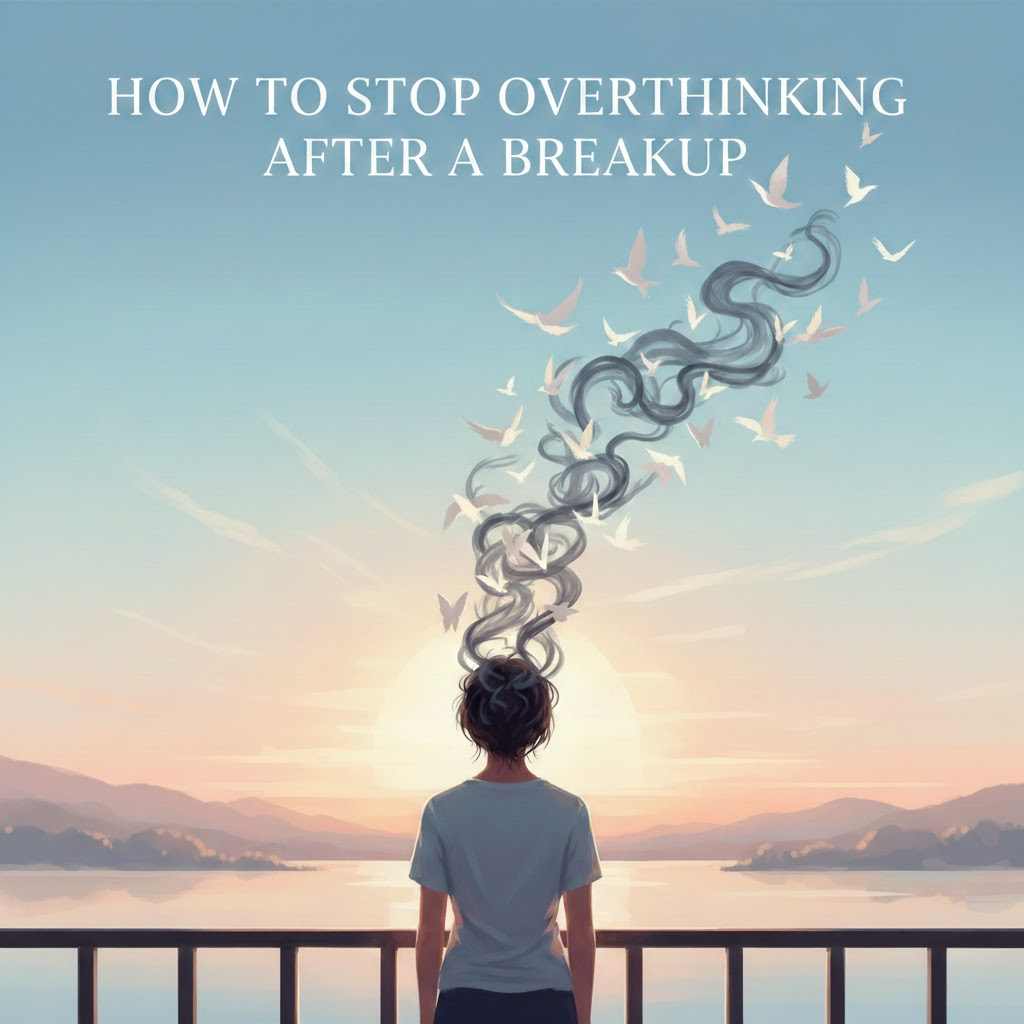
Introduction: The Mind That Won’t Quiet Down
It’s 2 AM. The room is dark and silent — but your mind is anything but. You’re replaying that last conversation again. Word by word. Moment by moment. You’re dissecting every text message, every argument, every silent dinner. You keep asking yourself the same questions on an endless loop:
“What went wrong?” “Why wasn’t I enough?” “What could I have done differently?” “Will I ever feel normal again?”
This is the reality of overthinking after a breakup — and if you’re living it right now, you already know how completely exhausting and consuming it can be. It doesn’t just steal your sleep. It steals your appetite, your concentration, your joy, and your sense of self.
But here is something important you need to hear right now: You are not broken. You are not weak. And this is not permanent.
Overthinking after a breakup is one of the most common and deeply human responses to emotional loss. Your brain is simply trying to process pain and find answers in a situation that may never have a clean, satisfying explanation. And that’s exactly what makes it so hard.
Understanding Psychology: Why Do We Overthink After a Breakup?

To stop overthinking, you first need to understand why it happens in the first place.
When a romantic relationship ends, your brain doesn’t simply “switch off” the emotional bond. Neuroscience tells us that love activates the same reward pathways in the brain as addictive substances like cocaine. When that source of reward is suddenly removed, the brain goes into a state of withdrawal — desperately searching for answers, patterns, and a way to restore what was lost.
This is why breakup pain is so intense and so persistent. According to research published in the Journal of Neurophysiology, the same regions of the brain that process physical pain also activate during emotional rejection. In other words, heartbreak literally hurts — not just emotionally, but neurologically.
Your overthinking mind is not a sign of weakness. It is your brain doing exactly what it was designed to do: search for safety, meaning, and resolution. The problem is that in the case of a breakup — especially one without clear closure — those answers rarely come. And so the loop continues.
Common overthinking patterns after a breakup include:
- Rumination — Replaying the same painful memories and conversations over and over
- Catastrophizing — Convincing yourself you’ll never love or be loved again
- Self-blame — Taking on complete responsibility for the relationship’s failure
- Comparison — Measuring yourself against your ex’s new partner or life
- Future anxiety — Panicking about being alone, starting over, or “wasting time”
- Analysis paralysis — Thinking so deeply and so endlessly that you become emotionally frozen and unable to move forward
The Overthinking and Anxiety Connection

Overthinking and anxiety are deeply intertwined — they feed each other in a vicious, self-reinforcing cycle.
Overthinking creates anxiety. Anxiety creates more overthinking. Left unchecked, this cycle can escalate into chronic stress, disrupted sleep, loss of appetite, social withdrawal, and in more serious cases, clinical depression.
The American Psychological Association identifies repetitive negative thinking as one of the key risk factors for both anxiety disorders and depression. This means that addressing overthinking after a breakup is not just about “feeling better” — it is genuinely important for your long-term mental health.
Warning signs that your overthinking has crossed into something more serious:
- Thoughts of self-harm
- Inability to sleep for more than a few hours consistently
- Losing significant weight due to loss of appetite
- Complete withdrawal from friends, family, and social activities
- Inability to perform basic daily tasks or responsibilities
- Persistent feelings of worthlessness or hopelessness
10 Detailed, Practical Tips to Stop Overthinking After a Breakup
Tip 1: Give Yourself Full Permission to Grieve
Before you can move forward, you need to feel. Many people make the mistake of trying to “snap out of it” or pretend they’re fine before they’ve genuinely processed their emotions. This doesn’t work. Suppressed grief doesn’t disappear — it goes underground and resurfaces later, often in more damaging ways.
Set aside dedicated time each day to feel your emotions fully. Cry. Write. Scream into a pillow if you need to. The goal is not to wallow — it’s to process. There is a significant difference between the two.
Tip 2: Implement an Immediate Social Media Detox
Social media is the single biggest trigger for overthinking after a breakup. Seeing your ex’s posts, stories, check-ins, or new relationship status can undo weeks of emotional progress in a single scroll.
Take these steps immediately:
- Unfollow or mute your ex on every platform
- Remove them from your close friends or followers lists
- Consider deleting social media apps entirely for 30 days
- Ask mutual friends not to share updates about your ex
This is not avoidance. This is strategic protection of your healing environment.
Tip 3: Practice the 5-4-3-2-1 Grounding Technique
When your thoughts are spiraling out of control, grounding techniques bring you back into your body and the present moment. The 5-4-3-2-1 technique is one of the most effective:
- 4 things you can physically TOUCH
- 3 things you can HEAR
- 2 things you can SMELL
- 1 thing you can TASTE
This exercise engages your five senses and interrupts the overthinking loop by anchoring your attention in physical reality. Practice it every time you feel your thoughts beginning to spiral.
Tip 4: Start a Dedicated Journaling Practice
Journaling is one of the most scientifically validated tools for emotional processing and mental clarity. When your thoughts exist only inside your head, they feel infinite, overwhelming, and inescapable. When you write them down, they become finite, manageable, and separate from your identity.
Powerful journaling prompts for breakup recovery:
- “What am I feeling right now, and where do I feel it in my body?”
- “What story am I telling myself about this breakup — and is it definitely true?”
- “What did this relationship teach me about what I truly need?”
- “What would I tell my best friend if they were going through this?”
- “Who am I outside of this relationship?”
Tip 5: Set a “Worry Window”
Trying to completely suppress overthinking often backfires — what you resist persists. Instead, try scheduling a designated “worry window” of 15–20 minutes each day. During this time, allow yourself to think about the breakup freely.
When the timer goes off, close the worry window and consciously redirect your attention to a specific task or activity. Over time, this technique trains your brain to contain overthinking to a specific, limited time frame rather than allowing it to bleed into every moment of your day.
Tip 6: Challenge Your Thoughts with the “Is It True?” Test
Not every thought your mind produces is a fact. After a breakup, your mind will generate countless distorted, catastrophic, and self-critical thoughts. Learning to challenge these thoughts is a core technique from Cognitive Behavioural Therapy (CBT) — one of the most effective evidence-based approaches for anxiety and overthinking.
When a painful thought arises, ask yourself:
- “Is this thought definitely, 100% true?”
- “What evidence do I have that supports this thought?”
- “What evidence do I have that contradicts this thought?”
- “What would a rational, caring friend say to me right now?”
- “Will this thought matter in 5 years?”
This process of gentle, rational questioning creates a space between you and your thoughts — allowing you to observe them rather than being consumed by them.
Tip 7: Use Physical Activity as Emotional Medicine
Exercise is one of the most powerful and underutilised tools for breakup recovery. When you exercise, your body releases endorphins — natural neurochemicals that reduce pain, elevate mood, and counteract stress hormones like cortisol.
You don’t need to become a gym enthusiast overnight. Start small:
- A 30-minute evening walk every day
- A beginner yoga class focused on stress relief
- Dancing alone in your room to songs that make you feel powerful
- Swimming, cycling, or any activity that genuinely brings you joy
Tip 8: Rebuild Your Personal Identity
In long-term relationships, our sense of self can become deeply intertwined with our partner’s identity. We make joint decisions, adopt shared routines, and begin to define ourselves partly through the relationship. When that relationship ends, it can feel like losing a part of yourself.
Rebuilding your personal identity is one of the most empowering aspects of breakup recovery. Ask yourself:
- “What did I love doing before this relationship that I stopped doing?”
- “What have I always wanted to try but never did?”
- “What kind of person do I want to be in my next chapter?”
Pick up an abandoned hobby. Start a new skill. Travel somewhere alone. Reconnect with friendships you may have neglected. Every step you take toward your own life is a step away from overthinking about someone else’s.
Tip 9: Practice Mindful Single-Tasking
Our culture glorifies multitasking — but for an overthinking mind, doing multiple things at once creates more mental noise, not less. Practise the art of single-tasking: doing one thing at a time with your full, undivided attention.
- Eat without scrolling through your phone
- Walk without earphones — notice the world around you
- Cook with presence — smell the ingredients, feel the textures
- Have conversations without half your mind elsewhere
Single-tasking trains your brain to focus in the present moment, which is the most powerful antidote to overthinking that exists.
Tip 10: Create a Morning Routine That Sets the Tone
How you start your morning determines the emotional tone of your entire day. A chaotic, unstructured morning — waking up and immediately checking your phone, lying in bed spiraling — sets you up for an overthinking day.
Build a simple, intentional morning routine:
- Wake up at a consistent time every day
- Spend the first 10 minutes without your phone
- Write three things you’re grateful for
- Move your body for at least 20 minutes
- Eat a nourishing breakfast
How to Live in the Present Moment: A Deeper Look
Living in the present moment is perhaps the single most important skill for overcoming overthinking. But it’s also one of the hardest — especially when your mind is trained to live in the past (replaying the relationship) or the future (dreading life alone).
Here are three deeper practices for cultivating present-moment awareness:
Mindfulness Meditation
Even just 10 minutes of daily mindfulness meditation can begin to rewire your brain’s relationship with intrusive thoughts. The goal is not to empty your mind — it’s to observe your thoughts without becoming attached to them. Apps like Insight Timer, Headspace, or Calm offer guided meditations specifically for heartbreak and emotional healing.
Body Scan Practice
Lie down comfortably and slowly bring your attention to each part of your body — from your toes to the top of your head. Notice sensations without judgment. This practice pulls your awareness away from mental chatter and into the physical reality of your body in the present moment.
Gratitude as a Daily Practice
Every evening, write down three specific things from that day that you are genuinely grateful for. They don’t have to be big — a good cup of tea, a kind message from a friend, a moment of unexpected laughter. Gratitude rewires the brain toward positive attention over time, making it progressively harder for overthinking and anxiety to dominate.
Frequently Asked Questions (FAQs)
Q1. How long does overthinking after a breakup usually last?
The timeline varies for everyone and depends on the length and intensity of the relationship, the circumstances of the breakup, and the support systems in place. Most people begin to notice significant improvement within 4–12 weeks when actively using healthy coping strategies. Professional coaching can dramatically accelerate this timeline. Without intervention, overthinking can persist for months or even years.
Q2. Is it normal to overthink a breakup even months later?
Yes, especially if the breakup was sudden, involved betrayal, or lacked closure. However, if you are still significantly impacted after several months, it is a strong signal that professional support would be beneficial. Prolonged overthinking that disrupts daily life may indicate complicated grief or the development of an anxiety disorder.
Q3. How do I stop replaying conversations in my head?
Use the “Is It True?” thought-challenging technique from CBT, practice the 5-4-3-2-1 grounding exercise whenever the loop begins, and use journaling to externalise the thoughts.
Q4. Can overthinking after a breakup cause physical health problems?
Absolutely. Chronic overthinking elevates cortisol levels — the body’s primary stress hormone — which over time can disrupt sleep, weaken the immune system, cause digestive issues, and even contribute to cardiovascular problems. Taking care of your mental health is directly taking care of your physical health.
Q5. Should I reach out to my ex for closure?
In most cases, no. Reaching out to your ex for closure typically prolongs the healing process, reopens emotional wounds, and often leaves you feeling worse rather than better. The closure you need is internal — and it is fully available to you without your ex’s involvement. Our coaches at MaitriPushp specialise in helping you find this internal closure.
Q6. What is analysis paralysis and how do I overcome it?
Analysis paralysis is the state of being so overwhelmed by overthinking that you become emotionally and practically frozen — unable to make decisions, take action, or move forward. It is overcome through structured action-taking (starting very small), mindfulness practices that reduce mental noise, and professional coaching that helps you break the cycle of paralysis.
Q7. How does journaling specifically help with breakup overthinking?
Journaling transfers your thoughts from the infinite space of your mind to the finite space of a page. This externalisation makes thoughts feel more manageable, allows you to identify irrational patterns, and creates emotional distance between you and your pain. Research shows that expressive writing about emotional experiences reduces psychological distress and improves long-term wellbeing.
Q8. I feel like I’ll never stop loving my ex. Is that true?
It feels that way now — and that feeling is completely valid. But the human heart has a remarkable capacity for growth, expansion, and new love. What you’re experiencing is the pain of loss, not a permanent limitation on your ability to feel joy or love again. Thousands of people who felt exactly as you do right now have gone on to build beautiful, fulfilling relationships. You will too.
Q9. Can exercise really make a difference to overthinking?
Yes — significantly. Exercise releases endorphins, serotonin, and dopamine — all neurochemicals that directly counteract anxiety, stress, and depressive thinking. A landmark study published in the Archives of Internal Medicine found that regular exercise was as effective as antidepressant medication for treating mild to moderate depression. You don’t need to run a marathon — start with 20 to 30 minutes of movement daily.
Q10. How do I know if I need professional help for my overthinking?
Consider seeking professional support if: your overthinking has persisted for more than 6–8 weeks with no improvement; it is significantly impacting your work, sleep, or daily functioning; you are experiencing persistent feelings of worthlessness or hopelessness; or you have thoughts of self-harm.